Showing posts with label Money. Show all posts

Tuesday, April 12, 2011

Surviving the Recession

Before getting married I had saved up a good amount of money outside of retirement that I ended up consolidating into one investment account. I kept almost all of my savings in the market as it is "flagged" for retirement and I was in for the long haul.

Then the recession hit - and at the bottom I had lost more than half of the money I had saved!! Those were some tough times - I thought I had been doing the right thing by saving as much as I could while I was single and then looking at my account and losing something around 66% of that money at one point! YIKES!

At least we didn't panic and knew we were in for the long haul and it just so happens I went to look at my account today and it is finally positive! So NET - we haven't "lost" any money any more - but we lost 5 years of investing time.

In a way I can't believe the market has come back so much. I hope it starts growing again as this has been a lost decade basically.


I learned a few things from this experience - I had previously owned some CDs and other such savings and thought if I didn't need that money than I should put it in the market - so everything was in the market! When our savings was down 66% if I had to take any money out for an emergency or to buy a car or go on vacation - it would basically have cost us 3x what it would have cost if we had more in "liquid" savings. So since the recession I have been building up savings outside of retirement which is NOT in the market. Suze Orman suggests having 8 months of expenses in liquid savings - while we are not there - we now have money we used to refinance and go on vacations with that we are building up in an online savings account. It used to get close to CD rates (I opened it at 5.05%) however now it gets less than 1% interest - but at least it is not in the market if we ever need it.

I think people always say things like this - but then when the market is returning 16% you hate leaving money in cash that you could be making a return on - though now I learned why - I'd say I learned it the "hard way" but we really survived the recession quite well. I only wish we could have save more over the past 2 years but that was not the case. At least my "life's savings" is whole again - now it's time to GROW!

Thursday, February 24, 2011

It's the Inequality, Stupid

This is my blog version of a "re-tweet" of an interesting article. Thanks to Karen for pointing me to this article - even though I can't see any content on Facebook as I have opted out of Facebook. I've been interested in income inequality for sometime. Here was a good publication from 2004 and it's only gotten worse!

As a response to "Joe the Plumber" and his claims of Obama's 3% tax increase on income over $250,000 being called socialism or re-distribution of wealth - the evidence suggests that there has been a LONG history of income re-distribution however it is going from the middle-class to the wealthiest income earners. And this is structurally put into the laws.

To me there is nothing wrong with making a lot of money - however I'm not sure why all the rules are written to the benefit of the wealthiest (and they are!). Well - I know WHY - because the rich and powerful write the laws (or influence the politicians that do). I can't figure out why income your money makes in the stock market is taxed at a lower rate (capital gains) than income people make by laboring day in and day out. I can't figure out why the effective tax on many corporations is ZERO and why the effective tax rate of the wealthiest is less than the upper middle class. If you are at or around the AMT line - you are paying THE HIGHEST EFFECTIVE TAX RATE!

Quick side rant - I personally believe most financial companies are merely siphoning money out of the middle class and consolidating it into the hands of very few - which is why I manage all of my own finances and investing. Maybe said a better way - I'm not convinced that financial firms are actually adding value to the economy as a whole.

On the flip side - I also can't figure out why more than 50% of Americans don't have any federal tax liability when they use public services too - but you can see how the standard deduction was put in to offset everything else in this article below.

I hope we drastically change the tax code for individuals and businesses to make it a straight calculation based on income - and then you'll find the tax rate will be MUCH lower because there will be no loop holes or deductions for some and not for others.

http://motherjones.com/politics/2011/02/income-inequality-in-america-chart-graph


Eleven charts that explain everything that's wrong with America.


How Rich Are the Superrich?


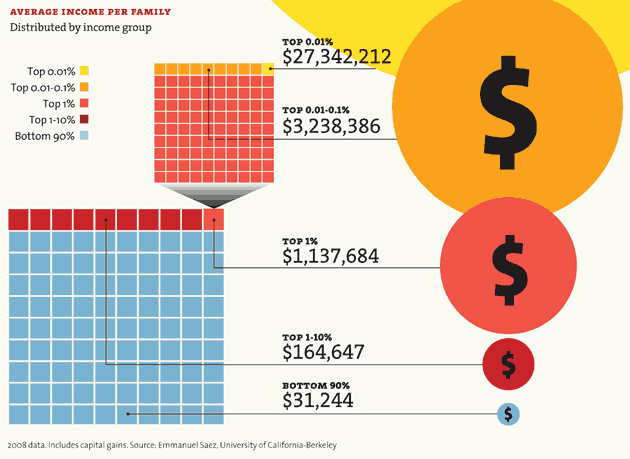
A huge share of the nation's economic growth over the past 30 years has gone to the top one-hundredth of one percent, who now make an average of $27 million per household. The average income for the bottom 90 percent of us? $31,244.

Average Income by Family, distributed by income group.
Advertise on MotherJones.com
The richest controls 2/3 of America's net worth


Note: The 2007 data (the most current) doesn't reflect the impact of the housing market crash. In 2007, the bottom 60% of Americans had 65% of their net worth tied up in their homes. The top 1%, in contrast, had just 10%. The housing crisis has no doubt further swelled the share of total net worth held by the superrich.


Winners Take All


The superrich have grabbed the bulk of the past three decades' gains.

Aevrage Household income before taxes.


Out of Balance


A Harvard business prof and a behavioral economist recently asked more than 5,000 Americans how they thought wealth is distributed in the United States. Most thought that it’s more balanced than it actually is. Asked to choose their ideal distribution of wealth, 92% picked one that was even more equitable.

Average Income by Family, distributed by income group.


Capitol Gain


Why Washington is closer to Wall Street than Main Street.

median net worth of american families, median net worth for mebers of congress, your odds of being a millionaire, member of congress's odds of being a millionaire
member max. est. net worth
Rep. Darrell Issa (R-Calif.) $451.1 million
Rep. Jane Harman (D-Calif.) $435.4 million
Rep. Vern Buchanan (R-Fla.) $366.2 million
Sen. John Kerry (D-Mass.) $294.9 million
Rep. Jared Polis (D-Colo.) $285.1 million
Sen. Mark Warner (D-Va.) $283.1 million
Sen. Herb Kohl (D-Wisc.) $231.2 million
Rep. Michael McCaul (R-Texas) $201.5 million
Sen. Jay Rockefeller (D-W.Va.) $136.2 million
Sen. Dianne Feinstein (D-Calif.) $108.1 million
combined net worth: $2.8 billion
10 Richest Members of Congress 100% Voted to extend the cuts
Congressional data from 2009. Family net worth data from 2007. Sources: Center for Responsive Politics; US Census; Edward Wolff, Bard College.


Who's Winning?


For a healthy few, it's getting better all the time.

Gains and Losses in 2007-2009, Average CEO Pay vs. Average Worker Pay


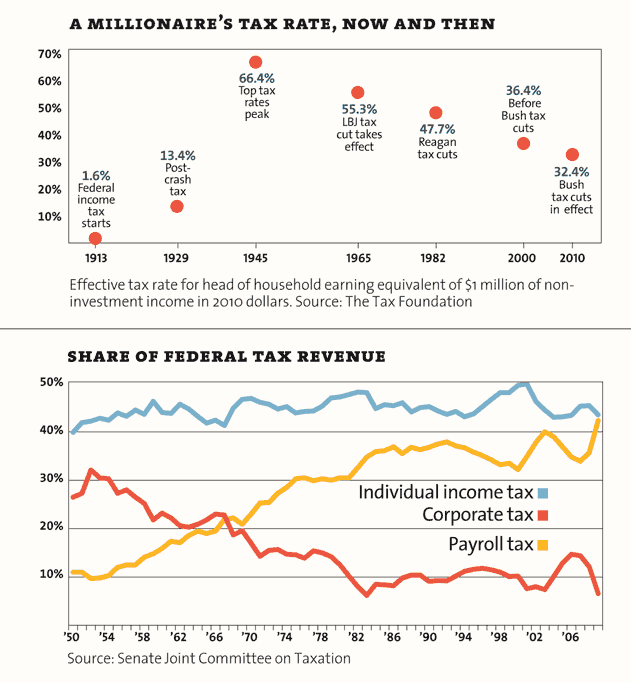
A millionaire's atx rate, now and then. Share of Federal Tax revenue


YOUR LOSS,THEIR GAIN


How much income have you given up for the top 1 percent?

 
Sources

Income distribution: Emmanuel Saez (Excel)

Net worth: Edward Wolff (PDF)
Household income/income share: Congressional Budget Office
Real vs. desired distribution of wealth: Michael I. Norton and Dan Ariely (PDF)
Net worth of Americans vs. Congress: Federal Reserve (average); Center for Responsive Politics (Congress)
Your chances of being a millionaire: Calculation based on data from Wolffhousehold and population data)   (PDF); US Census (
Member of Congress' chances: Center for Responsive Politics
Wealthiest members of Congress: Center for Responsive Politics
Tax cut votes: New York Times (Senate; House)
Wall street profits, 2007-2009: New York State Comptroller (PDF)
Unemployment rate, 2007-2009: Bureau of Labor Statistics
Home equity, 2007-2009: Federal Reserve, Flow of Funds data, 1995-2004 and 2005-2009 (PDFs)
CEO vs. worker pay: Economic Policy Institute
Historic tax rates: Calculations based on data from The Tax Foundation
Federal tax revenue: Joint Committee on Taxation (PDF)

Read also: Kevin Drum on the decline of Big Labor, the rise of Big Business, and why the Obama era fizzled so soon.
More Mother Jones charty goodness: How the rich get richer; how the poor get poorer; who owns Congress?
Dave Gilson is a senior editor at
Mother Jones. For more of his stories, click here. Get Dave Gilson's RSS feed.

Monday, December 28, 2009

A rant on Bailouts + Taxes + Education

Do you remember when President Bush pushed through a landmark bailout plan saying:

"This legislation will safeguard and stabilize America's financial system and put in place permanent reforms so these problems will never happen again"

The citation is the shocker - as this is a quote from George H. W. Bush (senior) in 1989 during the Savings and Loans scandal. This bailout was for an unprecedented sum (at the time) of $66 billion. Sounds a lot like George W. Bush in September of 2008 when he pushed through a landmark bailout saying:

"We'll make sure, as time goes on, this doesn't happen again. In the meantime we got to solve the problem. And that's why people send me the Washington D.C."

Like father like son 20 years apart. But don't worry - this isn't a bust on the Bush's for government spending - as we all know Clinton repealed the Glass-Steagall Act of 1933 which had put up a firewall between savings banks and investment banks after the great depression.

I think it's a great point to look at political stereotypes - which are that Republicans are against government spending - though in additon to the two bailouts mentioned the Bush presidents and Regan count for a huge majority of the national debt. Though credit Bush senior for recognizing that we needed to raise taxes to lower the debt - though he broke his promise of "read my lips - no new taxes" and his own party revolted against him making him a one term president and paving the way for Clinton. Credit Clinton for having left a huge budget surplus which would have cut the national debt in half from $10 trillion to $5 trillion had Bush Jr. not passed his famous (and overwhelmingly popular) Bush tax cuts (mostly for the wealthy) that ran the national debt up to the $10 trillion dollar figure.

The other stereotypes are that Democrats are all for big government and increasing regulations - but Clinton's administration de-regulated banks allowing the crazy derivative investments that seem to have been a major cause of the current recession.

NET - my point is voting by ideology is misguided as we Americans (in general) don't vote for the tough medicine. It is popular to cut government spending but no one wants to cut medicare to the elderly. In fact the Republicans recently balked at the Health care reform provisions seeking to cut $500 billion dollars of "waste" out of medicare stating that the elderly will suffer. Fine! I am all for spending money if we all agree to fund it - by raising taxes. But NO ONE can run on raising taxes - it is immensely unpopular. But then poeple who voted against it then say "I am affraid of the national debt and passing that burden on to our children!" Well - start voting with you mind and not your ideology. You may disagree with large government - but if we have ALREADY spent $12 trillion dollars more than we brought in over the past 30 years - then guess what - it's time to raise taxes!

I am in a minority who don't react violently to the thought of higher taxes - and we would pay one of the highest tax brackets on our money. We live comfortably, save for retirement, and even enjoy splurges like vacations. An additional 3% tax (moving from 38% to 41% bracket) on money over $250,000 (which we don't make) is what is proposed, but let's assume it was an additional 3% tax on money over $50,000 - it's really not a life changing sum for us (and I argue for anyone making over $50,000 per year) but would help solve numerous budget issues not the least of which being the national debt, but then would fund health care reform (if you are opposed to the government spending part since the public option is gone) as well as educational programs.

In fact I'd like our government to pay off the national debt and then create a government surplus to pay for disasters or wars with savings - like normal people do when they have unplanned expenses. Though I believe it is bad national policy when you can print money - so I think carrying some debt helps invest and you build for today - though it is unpopular. There are also those who don't think the government should have a savings built up as that is "our" money as tax payers and the government shouldn't have it.

And Finally - an unorganized rant on education - I believe if fundamentally an economy is all about GDP (if you make the assumption that your production matches your consumption but that is another blog) - so you can transpose GDC ( as in consumption) though it's not as easy an index that is tracked like GDP so NET - if our country is a person, our GDP is like our salary - or a measure of our productivity to society - and the best way to raise that is through education. So I am all for the government providing low interest loans directly to students. The win-win is that tax payers make money (maybe 2-3% on the investment) and students get lower rates than the currently crippling 6-7% student loan rates just because many feel ideologically that it is un-American for the government to profit a little - but "American" for bank CEOs to get huge bonuses off of the back of students and stick the money in their "fat-cat" pockets.

I think there is a fair skepticism to say that the government is not an efficient way to use our money - and there is waste and corruption in politics - I just don't believe the solution to this issue is to line the pockets of elite private citizens who are efficient in funneling money to their own bonuses. I'm not against corporations or "free markets" in general - but not necessarily for public works, especially when free market forces don't translate to doing the right thing for the economy - as you can see that bank CEOs motivations were not in the best interest of the economy - but rather in their own. People are outraged to hear that banks receiving bailout are paying out huge bonuses - but those in power in companies are not prone to "market forces" as much as personal gain. Hence driving businesses into the ground. regular employees lose their jobs, these guys get millions in parachutes - and we complain about the inefficiencies of government as a justification to continue this cycle?

Fear of big government (in my opinion) has been an ideology that has made the rich richer supported on the ideological votes of the poor who "don't trust the government".

Sunday, December 13, 2009

Retirement "Secrets"

I've been thinking about retirement planning recently, and I have a retirement model for Meghan and I that I update annually. But I was thinking about creating a general retirement model as I found out some interesting things.

Pass this along to anyone you know in college or just starting out in the workforce:

The "secret" to retirement is to save 10% of your income (before taxes) every year. For example if you make $40,000 per year out of college - save $4,000 per year or $333 per month. This also means that as your income increases, your savings must increase as well to stay at 10% of your total income.

Let's look at the model:


The reddish line (sorry I have Office 2007) represents income per year. In this scenario it starts at $40,000 per year at age 23. As you can see at age 65 the income stops. That's why we are saving for retirement. After 65 (assuming that's when you want to retire) we need to live off savings. (In terms of retirement 65 is the new 55).

The short teal-ly blue line way below out income is our annual savings (10%).

The more smurfy-blue line that quickly jumps off the page is our retirement balance which thanks to compounding grows exponentially with each years of savings and growth. As you can see when our income stops - we live off of this smurfy-blue line which eventually crashes to zero at 90.

The pumpkin orange line is the growth of our retirement each year. As you can see - it quickly becomes a meaningful force working for our retirement. After about 10 years of saving - the growth on our savings contributes as much per year to our retiement as we svae from our income. It's like an additional employed member of the family saving 10% of their income for you! (only better because they don't spend any money). As we spend our retirement after age 65, the growth of our savings declines as we withdraw money to live on, and it to crashes out at 90 in this model. (It looks like it crashes a year after our retirement savings is depleted but that is just an artifact of my lazy annual compounding versus monthly).

The frog green line starting at 65 is social security. The reality is 23 year-olds today won't be eligible for full social security until 67, however you can take a reduced amount starting at 62, this model is somewhere in between. It may also be a leap to say there will be any social security in 30 years or so.

The plum purple line (not shown) are living expenses after retirement which are all below the x axis (negative). 80% of pre-retirement income is a "rule of thumb" that factors in empty nest'ers and possibly paying off your mortgage by that point as well as averaging the fact that you may be more active in retirement at 65 but slow down your spending by 90.

OK - so this isn't earth shattering - but I learned some interesting things running this model.

- It doesn't matter how much money you make - the 10% rule still holds

Let's look at a starting salary of $20,000


Or a starting salary of $100,000


Now for some quick examples of compounding. If you were able to save just 14% of your salary (or $466 per month starting with out $40,000 salary example) then you would not only be able to retire, but live off the interest of your retirements and never touch the principle. Therefore your retirement fund will "last forever" and you can pass on a huge sum to your children (in this example $5,600,000). This difference isn't far from just giving up cable each month (watch TV on hulu.com instead).

14% savings model


If you only save 5% per month (every month) then your retirement savings will only last until you are 75 in this model - or just 10 years after retirement.


Another compounding example - if the return on our investments nets 10% per year rather than 8% then 5% savings per month would last until 90 and therefore work for this model.


This is not a "crazy" scenario as the S&P500 index has returned 10% per year for the last 30 years. However the S&P500 has also returned 0% over the past 10 years and -5% for the past 3 years. Long story short - relying on 10% growth is not recommended.

Retirement Matching
So if you need to save 10% of your salary per year - what about 401k matching? If you are lucky enough to have an employer who matches your 401k savings - The most common is a 50% match up to 6% of your salary - or a 3% contribution to your retirement - reducing your burden to 7% per year.

Some Personal Notes
In addition to saving for retirement on our own - Meghan and I are fortunate enough that P&G has a profit sharing program. It's one of those things you don't think anything about when looking for your 1st job, but later makes a big difference. P&G's profit sharing doesn't require you to save any money for retirement (like a 401k match does). P&G just contributes money to your retirement. It starts at 5% per year and increases almost 1% per year of service to a max of 22% of your salary per year after ~17 years. P&G's contributions are made in P&G stock and remain as P&G stock until you turn ~50. Can you imagine - they do this for EVERY employee. It is remarkable!

So is that it then? Just have P&G contribute money for my retirement? Well I know folks who retired recently without saving a dime of their own for retirement and retired with quite a sum. However over their careers P&G stock had returned 16% annually. I am skeptical that the next 30 years will yield as much growth - but everyone who recently retired tells me they felt the same way when they started with the company - so who knows.

Another "artifact" of working at P&G is that it seems quite challenging to be employed past 55 - and 65 might be unheard of unless you are an executive.

Let's look at our original retirement model when saving 10% per year trying to retire at 55


Yikes! We only make it to 66 with our savings! In fact - if you crunch the numbers, in order to retire at 55 - you must save almost 20% of your salary every year (19.5%)! Or $650 a month for our $40,000 salary example.

Here's the 19.5% annual savings model


So what's the point of all of this?
- You will likely live longer than you can work.
- You need to save enough money during your working years to cover your expenses after retirement
- Saving for retirement isn't easy - but your need to do so doesn't change

I know some folks who start working at P&G and plan to save for retirement "later". They say it's hard to start out with their pay check and save for retirement. They assume their income will grow and eventually they will be able to save. Of course things will get in the way later as well, like buying an engagement ring, paying for a wedding, buying a house, having kids, etc. And the longer you wait to start, the more money you have to save.

It all comes down to 10% per year - every year.

I wish you all the best of luck with saving for retirement!

APPENDIX: Retire at 65 Assumptions
- You are living off your parents from Age 0-18
- After 23 you live within your means to pay back any student loans while still saving 10% annually
- Save 10% of income before taxes annually starting at age 23
- Retire at 65
- 8% annual growth rate (S&P500 10.34% annually over last 30 years)
- 3% annual inflation
- 4% pay increase annually
- Spend 80% of salary at time of retirement
- Assume you actually get Social Security
- Lifespan of 90 wonderful years

Thursday, December 03, 2009

Recession Datapoint(s)

Meghan and I bought our house at the very peak of the market - APR 2006. I think interest rates and housing values have only fallen since. And because of that we are refinancing to a lower interest rate (from 6.5% to 5.125% though you can get 4.875% but it would take too long to explain the challenges of refinancing a non-conforming 80/20 loan - which is why we haven't refinanced until now). In order to do so we had to have an appraisal on our house. So we know that officially our house value has dropped 3.36% since then. I actually feel like that isn't too bad (which is a sad commentary on the state of the economy). Also for what it's worth Zillow's Zestimate was spot on.

While the housing market (and interest rates) may be bottoming - the stock market has had a pleasant rally. Had we panicked and changed our investment strategy we would be sorry today as the S&P 500 is up over 60% from the bottom - which amazingly enough was only 9 months ago in MAR 2009. While we are still ~17% below our 2007 highs - I feel much better about our savings balances.

Thursday, January 15, 2009

Topics I love!

I was listening to a caller on a radio show who was upset that a comedian was making fun of religion. And she reminded me of something you often hear: NEVER talk about money, politics or religion.

Only I think that is a bunch of BS. I agree that you should be aware of your audience and I try not to talk about these things in the formal work environment, though sometimes lunch conversations can get interesting.

BUT - As you can see from the blog labels for this blog - I love talking about these things! I just think you have to be sure to have the right audience.

I am so very thankful to have a group of friends who like to talk about money. I have learned so much about saving for retirement form this group of friends as we openly share our approaches and strategies. I think you should find people of similar economic levels because then you don't have to worry about people's feelings as specific dollars are talked. I for one now am much more comfortable talking about money and have no insecurities as I talk to folks who are quite wealthy or close to retirement and have millions of dollars saved. There are no hard feelings because I have spent a lot of time looking at my specific situation with the help of friends who like to offer advice or support and I am not insecure about our current situation - so I don't have any issues talking with people who are "better off". It's just real world - I don't believe we all have to be equal to have respect for one another and have intellectual conversations.

The same goes for religion. If I could pick one topic that I believe more people should discuss it would be spirituality. I think there are very few things in life that can be such a big part of your life that you had NO CONTROL OVER. Most people inherit their religious beliefs (and religion for that matter) from their parents. I believe at some point when we all grow up and become adults - that it is fair game to take a survey of what is offered globally by way of spiritual thinking and making a decision of what fits for you versus basically having that decision made for you when you are a child.

I think where this falls apart is where people are threatened or offended by other ways of thinking. To me I am all for everyone having their own ideas on religion - but the worst is when someone thinks their ideas should be adopted by others. I am happy to discuss the different views everyone has but at the end of the day I think it is about each person's individual connection to their spirituality.

So I am very thankful to have friends and family-in-law who are exploring different religious or spiritual ideas and discussing them or suggesting good books to read. I think 2009 will be a big year for me to do more meditating and reflect upon "me" more than other years where I have spent most of my energy externally (job, money, retirement, etc).

Politics is very fascinating to me because it combines religious and financial views into what people push for in public policy. The same warnings about money and religion apply but it gets even stickier. I am so thankful to have friends with various views who can openly talk about the trade-offs to all of our approaches.

I believe some of the best intellectual conversations include these 3 "taboo" topics and they encourage indivicual growth and acceptance of others. I would encourage everyone to completely ignore the advice to "never" talk about these topics - only find the right audience in your life to do so.

Sunday, January 11, 2009

Our Financial Review 2008

I just finished our 2008 finances. It was another good year - I feel blessed that we are able to do a decent job saving for retirement while spending some money on things like the Cats and some new appliances this year. In fact - I was shocked to see that with all of the variable expenses we have - we spent within $900 of what we spent total in 2007. Pretty remarkable! Exchange our 2007 couches and landscaping for cats, appliances, and painting the finished basement and it's a push!

So why do I have a bitter taste in my mouth financially from 2008? Well - like many I am pretty upset about the financial collapse of 2008. Really, for broad indexes to be down 40% in one year is ridiculous. I agree that our government over the past 8 years was asleep at the switch while the economy eroded from the inside out. By the time it hit main street - all the fat cats on wall street were gone with their golden parachutes. In fact - it brings up 32 major questions which couldn't possibly be covered in this blog:

1) Why would any well organized and well run company want to go public anymore? The trend of future companies (in my opinion) will be less public capital(and more private).
2) What does this mean 30+ years down the road for investing in public companies if the best companies have incentives NOT to go public?

Here's a graphic of my retirement model which I started for my financial review last year (updated for 2008).


As you can see I have 2 "constant savings" curves for retiring at 55 and 65 based on our projected standard of living over that time. This is also based upon a life expectancy of 95.

I was most excited after putting this together to see that we were ahead of the "retire at 55" line. But as you can see in 2008 we fell below even though we CONTINUED TO ADD MONEY! The NET is continued savings but the entire value of our retirement savings was down about 30%.

I am not going to be too sour grapes over this because we again are blessed to have a long time before we retire and hopefully this will be a blip in the long savings curve - however I also believe we will have to lower our expected returns going forward assuming that the fundamentals of the economy were somewhat over stated as evidenced by this huge correction. I am most concerned about those who are very close to retirement or those who just retired. The effects could be devastating if you need to withdraw from market exposed fund currently.

My take-aways from the financial "crisis":
1) Retirement planning is a LONG term plan. It is never to early to start - I started at saving for my retirement at the age of 23.
2) Save MORE than you think you need to retire because you never know
3) Don't put money in the market that you will need within 5-10 years. If you put money in the market - assume you can't touch it for a decade.
4) I will begin to factor in "more secure" savings as part of our retirement plan (like CDs and bonds). At our age I didn't think we would need to but some balance to a portfolio can help you spend money now even while waiting for market funds to recover.
5) Related to step #4 - by the time you retire you should have little no market exposure - and don't plan on needing market returns after retirement! If you need 7-10% returns on your money in retirement you probably should supplement your income for as long as you can work after retirement.

This last point is especially true today. I know many P&Gers who retire at 55 but that is just not realistic in most situations. Think about working until 65 even if you can "retire" from a Fortune 500 company and then make some money while you are young and healthy to help supplement retirement spending.

I am much more optimistic about 2009 and the new administration so I wish you all a happy and prosperous 2009 full of abundance!

Monday, October 13, 2008

Depressing Headline of the Week

From Yahoo! Finance:

"Dow Soars to 9,000"

:(

Thursday, October 02, 2008

How I would fix the Economy without a Bailout

I think we need to all agree the bailout is a bad idea. Whether you believe Ron Paul for saying it provides a false bottom to an economy while not growing demand to match it, or whether you believe it sets a bad precedent that wall street can run business irresponsibly while fleecing money from main street with no repercussions because the government will bail you out. Fundamentally it is flawed to let business run in the ground by poor management to continue to be in business on the tax payer's dime.

So why the bail out? "The core of the bill allows the Treasury Department to buy $700 billion in bad mortgage assets from banks, to be held and eventually sold off if and when the market improves. Ideally, with cleaner balance sheets, banks would start lending to each other again, loosening up the nearly frozen credit markets."

Here's my solution. I believe rather than continue you follow the failed trickle down economics with a penchant for deregulation that got us here in the first place and hope the $700 billion dollars "ideally encourages banks to start lending again" - I say let the banks run themselves into the ground and have the government resolve the credit crunch by DIRECTLY LENDING MONEY TO THE MARKET.

Yes. I am proposing that rather than buy up all the "toxic loans" to relieve the banks their burden and free up their cash to be lent out again - have the government instead profit by making home loans, car loans, business loans etc directly to the market. In fact - if you want to stimulate the economy the government could loan money at lower interest rates than we have ever seen (think about a 3-4% home loan). And instead of the tax payers bailing out a cool $700 billion, have the tax payers turn a profit from this governmental lending.

BUT THIS IS OUTRAGEOUS! The government shouldn't be in business it would ruin an entire industry! Well - the financial industry did that all on their own, I say let them crash and burn but keep the economy stable through my plan. Additionally - I also propose that the natural progression of my plan should be for NEW banks to be created - and run responsibly, and slowly over time the government should reduce it's role in lending until the whole thing shakes out with a completely new crew of banks and the government is out of the industry all together.

Rather than wasting tax payer dollars on businesses who are fundamentally flawed, use the resources of the government to directly stabilize the economy for a period and make money for the tax payers in the process instead.

Just my two cents...

Thursday, September 18, 2008

Congress: Throw the bums out!

In case you still believe Congress is working for you the regular Joe. Here's a great summary of their busy calendar.


This is why I am a supporter of term limits. Of course - many people argue that we don't need term limits because these politicians are up for re-election, however relying on the american public to know enough to figure this out is probably what got us here in the 1st place!

Perks of being in congress:
1) free from arrest in all cases, except for treason, felony, and breach of the peace
2) a member of Congress may not be sued for slander because of remarks made in either house
3) As of 2006 rank and file Members of Congress received a yearly salary of $165,200, this puts each of them in the top 5% of all income earners in the US.
4) Congressional members are covered by the Federal Employees' Retirement System. In 2006, the average annual pension for retired senators and representatives was $60,972 for life (still the top 25% of income earners even after they stop working)! This of course includes governmental health insurance & benefits - all on the tax payers dime!

I hate to sounds like Lou Dobbs (the grumpiest man on TV) but how can you not read this an be outraged! When the poeple in congress are the financial elite - no wonder the average american is not at the center of their work.

Don't even get me started on lobbying.

Friday, July 18, 2008

Signs of a Recession

To be clear, we aren't technically in a recession (2 quarters in a row with negative GDP) but you can't mistake the pessimism in the market. Here is an example, a title from a Yahoo! Finance article:

Citigroup posts $2.5B loss, but beats expectations

http://biz.yahoo.com/ap/080718/earns_citigroup.html

Thursday, June 19, 2008

Uncle Sam is an Idiot!

Ok - so reading Yahoo! Finance about retirement I stumble upon this article which really plays up the value of a new online retirement calculator:

An improved tool from Uncle Sam is one of the best resources available to help calculate your retirement finances.

Most people have the same first question about retirement: How big a nest egg will I need? Two years ago, the Employee Benefits Security Administration, part of the Department of Labor, published "Taking the Mystery Out of Retirement Planning." This smart, 62-page guide helps answer that question in a detailed, but easy-to-understand, manner.

And now it's even better. Now, these worksheets have been moved online and you can let the Labor Department's computers do the math.


I have used many online calculators and don't like most (which is why I have made my own retirement spreadhseets) - So I head on over to the new tool to see for myself and to use their sheet you must be between 50 and 70 years old!

It actually gives you an ERROR if you try to say you are younger.

NEWS FLASH for uncle Sam, if you are between 50 and 70, there isn't a lot of wiggle room to plan for retirement! You are already most of the way through with your plan! (Whether you knew it or not). Also my peers are VERY retirement focused and we are all in our 20's and 30's.

That's why Uncle Sam is an Idiot.

Monday, May 12, 2008

$4 per gallon gas

Today I filled up my car for $3.99 and 9/10 per gallon (thats $3.999). Not quite $4 but close enough. And I felt just fine about it. My car uses premium unleaded, but I get noticeably better mileage and more HP. Plus it's amazing on a percentage basis how much of a bargain premium gas is nowadays, you only need to get 3-6% better mileage for it to pay out (and your car likely will!). But the bigger picture is the fact that we pay relatively little for our gas compared to the rest of the world (especially the developed markets). We could have cheaper gas since the US is sitting on $1.3 trillion dollars worth of oil, but we won't drill in ANWR, which is fine with me but you can't have your cake and eat it too. So we pay higher gas prices, but not that high as the chart below details (Updated last month).

Gas Prices Around The World


As a quick aside: Rising energy prices is going to be a good thing for the future. We aren't too far away from making "green energy" more viable on a cost basis. As traditional means of energy become more expensive, we will be able to invest in solar or wind energy without requiring government subsidies to make them pay out. Once an alternative enery becomes profitable - it will tip.

Friday, March 14, 2008

The U.S. and Money

During this unofficial recession, who isn't thinking about money?

Here are two of the more interesting pieces of data I have come across while searching for financial info. I could blog volumes about each graph, but I won't, they are pretty fascinating by themselves.


Source: 1989-2004: Arthur B. Kennickell, "Currents and Undercurrents: Changes in the Distribution of Wealth, 1989-2004," Federal Reserve Board, Jan. 30, 2006, Table 1. 2005-06: Forbes.com.

So the wealth in the U.S. is split evenly 3 ways, the top 1%, the next 9%, and the bottom 90%. I believe this should be eye opening. I think it can be attributable (at least to some degree) to the fact that many people are going through the motions and clocking in, some people are constantly improving their skills to move into skilled labor, while very few others take another step and separate their labor from their income. You can only work so many hours, but intellectual property can earn limitless income without labor (think of patent holders, inventors, and business owners). You can't possibly believe that Warren Buffet, Bill Gates etc. are making 1,000,000 times other individuals incomes because they are working 1,000,000 times harder, they are putting their efforts into a totally different area. In stead of working or laboring, they are thinking and building. Napoleon Hill coined the phrase "Think and Grow Rich" he never said "Mindlessly Work Hard and Grow Rich" or "Be Lazy and Grow Rich".

Now - I am more concerned about the next graph.


Source: Bureau of Economic Analysis, National Income and Product Accounts, Table 2.1, Personal Income and Its Disposition.

As you can see the personal savings rate is in negative territory! I think many people are living beyond their means. It's now part of our culture, part of entitlement, part of irresponsibility, part of instant gratification, part detachment from reality, part gilded age (it's all a facade) - and it's great for the economy. In fact one could argue that the GDP is over inflated because we have compromised our own personal finances faster than we are truly growing the economy, but that's a whole other discussion. But clearly - the party's over - at least in the short run for a correction. And at the end of the day, there should be a lot of individual responsibility to run a home like a business. Instead, I believe personal debt is at an all time high, never mind saving for retirement. We'd rather spend today than save for tomorrow. In fact, our brains may be wired that way! And that may be the most amusing part. As far as we think we've come, to some degree we are still programmed in the animal kingdom. But those animals seem to do fine without ANY money!

(This blog really took some turns, even I didn't know where we'd end up!)

Wednesday, January 02, 2008

(My) Financial Year in Review

One thing I know - people are not comfortable talking about money. But I love talking about investing, saving for retirement, financing a car or a house, etc. I also think people should talk to each other more about money because this stuff is certainly not taught in school, and most people never care to research the matter. I am fortunate that I have a group of friends who like to talk about money and investing, and don't get caught up in comparing as much as just learning from each other.

In this spirit I will share my retirement update in hopes that you too will be inspired to take a look at where you are and where you want to be (if you need help this is one of my favorite retirement calculators). I make it a point to assess my path to retirement at least 2 times per year. Once around the New Year (that's this one) and once again at the end of the fiscal year when P&G contributes to my retirement.

From what I see - my peer group in general (Gen-X'ers) are avid savers for retirement, while Gen-Y'ers are planning to save fore retirement.... someday...
NET - the sooner you start the better!

I used the above mentioned calculator to determine how much money I would need to:
1) Retire at 55 (which is aggressive - now most people retire at 65, if at all!)
2) Continue our current lifestyle (spending) at retirement (inflation adjusted)
3) Have the retirement funds last until I am 85 (life expectancy estimate) - probably should have used 90 since Meghan is younger than me, but 25 years it a long lever arm. (also note that some calculators don't let you use them if you are under 40, that is just being lazy and poor programming. Of course people under 40 think about retirement now, you have to since the end of the pension era!)

Assumptions:
3% annual inflation rate
8% annual appreciation before and after retirement (see S&P 500)

So I graphed the savings curve predicted if one starting saving at 23 and retired at 55 with our desired retirement income - and then added our current retirement savings. I have removed all dollar values because people are uncomfortable about this stuff (which makes me uncomfortable blogging it!) but the net of it is the amount you need to save for retirement is always a lot more than you'd expect before you start looking into this stuff! The results are below.

I have to say that when I did this exercise I was shocked. As you can see it looks like Meghan and I are "on-track". However I always thought I was an over-zealous saver for retirement, especially since I started saving from the 1st day I started working. Before getting married and having a house I was extremely aggressive in saving for retirement, so I had hoped I would be in better shape.

In fact this exercise really started to bug me, so I had to reconcile in my head what was going on. So I next took my current retirement savings and current contributions and plotted their expected growth and got the plot below.

This plot made me feel a little better, and again pointed out how complicated this stuff is. It shows that at our current savings rate with 8% return per year that we are projected to be ahead of the curve!

I don't think the human mind is very well equipped to fully grasp exponential relationships. Is that why Einstein is supposedly quoted as saying "compound interest is the most powerful force in the universe."

So what does it all mean?
Well - the truth is somewhere in-between. I don't think we will be on the maroon curve because it implies that we continue to save for retirement at our current rate, but that is unlikely for the following reasons:
1) I just bought a car and have a car payment again after not having one.
2) We hope to have kids someday, and those darn things are expensive!
3) This also implies that P&G will contribute to my retirement until I am 55, which means I would continue to work there for another 25 years. I'm not saying it won't happen - I know people at P&G who do it all the time, but that sounds like a long time! 25 more years! I don't know how anyone does it for that long! I'm just hoping for a good OJP job in 2008 (I am changing assignments).

I am hoping to stay ahead of the green curve so I can retire at 55, but if that doesn't work out, working until 65 would exponentially help matters (10 more years of savings, 10 less years of retirement funds needed). Also Meghan and I have a good attitude of balancing saving for retirement with enjoying spending some money today. I remember when I worked on Pantene there always was a big debate with one specific manager about how wasteful a week of gambling in Vegas was, and how he'd never do it (he was on the deferred life plan - where you sacrifice today in hopes of enjoying what you want somewhere down the road). There really isn't a good financial reason to spend a week gambling in Vegas, but there are a lot of great times and great memories to he had (like collecting on the spoon bet!) if you budget for it.

My wish for anyone who took the time to make it through this long blog - have a prosperous 2008 and I hope your retirement plans either begin in 2008 or are re-energized because of this post!

PS - Just for fun I have attached the "retire at 65" savings curve. It's almost unfathomable how much leeway it gives you by working an extra 10 years!


Happy Retirement!